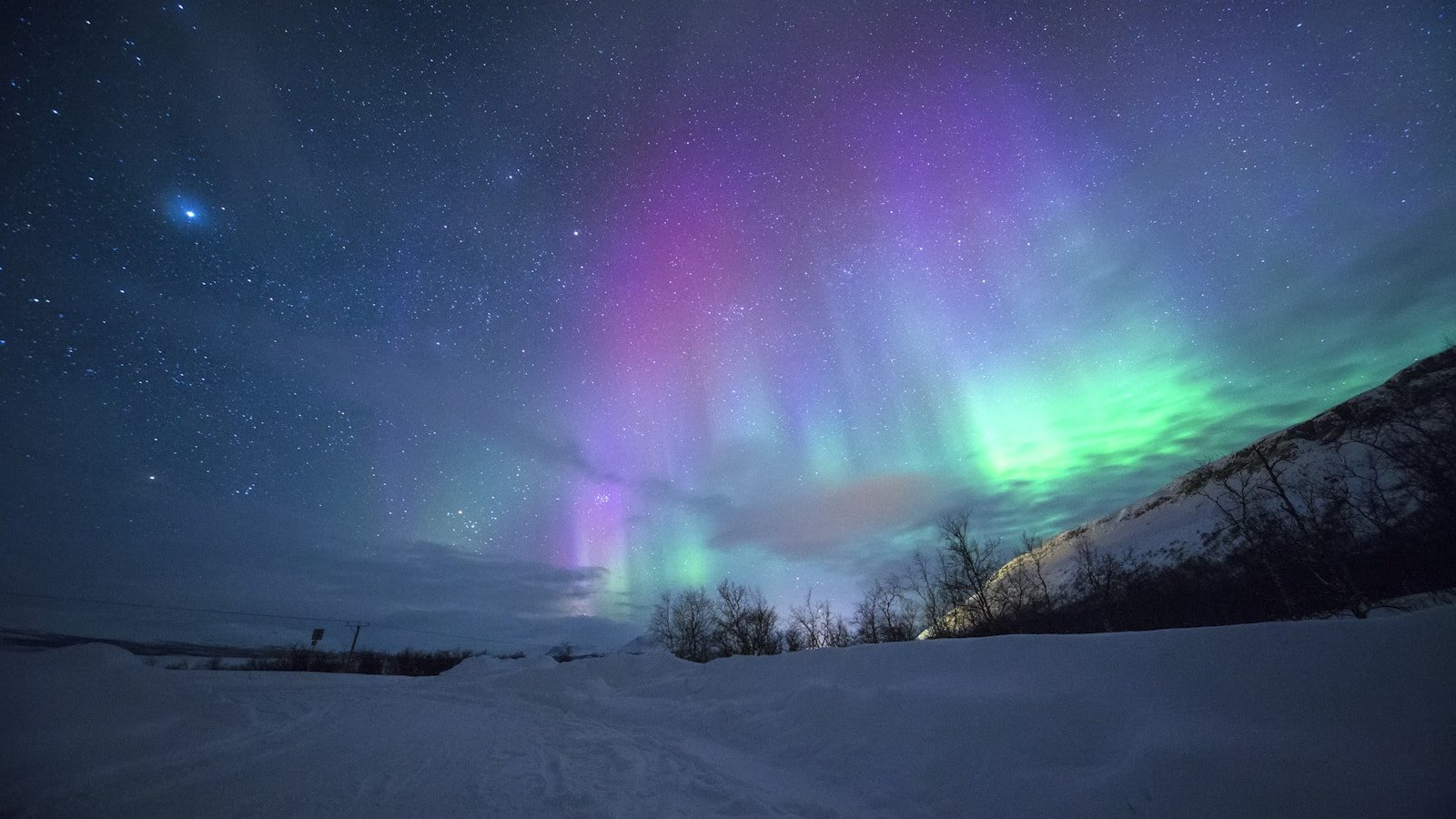
Image: NOAA/NWS Space Weather Prediction Center
Aurora displays are driven by solar activity, and predicting them has become increasingly practical thanks to real-time solar wind data and well-maintained alert services. You do not need a physics degree to follow an aurora forecast — but you do need to understand what the numbers mean.
This guide covers the forecasting chain from Sun to sky, explains the Kp index in plain terms, lists the alert services worth using, and provides a practical photography workflow for when conditions look promising.
The forecasting chain
Aurora forecasting follows a sequence:
- Solar event — a coronal mass ejection (CME) or solar wind stream leaves the Sun
- Transit — the solar wind or CME travels through interplanetary space (1–3 days for CMEs)
- Detection — the DSCOVR or ACE satellite at the L1 point (1.5 million km upstream) measures the incoming solar wind ~15–60 minutes before it reaches Earth
- Geomagnetic response — the solar wind interacts with Earth's magnetosphere, causing geomagnetic disturbance measured by the Kp index
- Aurora — energetic particles funnel along magnetic field lines into the atmosphere, exciting gas molecules and producing light
Key forecasting windows
| Window | Reliability |
|---|---|
| 1–3 days ahead (CME arrival estimate) | Moderate — timing can shift by ±12 hours |
| 1–4 hours ahead (L1 data) | Good — real-time solar wind measurements give solid short-term alerts |
| 15–45 minutes ahead (real-time Bz) | Best — if the IMF Bz component is strongly southward, aurora is imminent |
The Kp index explained
The Kp index is a 0–9 scale measuring global geomagnetic disturbance, updated every 3 hours. It is the most widely used single number for aurora forecasting.
| Kp | Geomagnetic activity | Aurora visibility |
|---|---|---|
| 0–1 | Quiet | Unlikely except at very high latitudes |
| 2–3 | Unsettled | Visible from northern Scandinavia, Iceland, northern Canada/Alaska |
| 4 | Active | Visible from Scotland, southern Scandinavia, northern US states |
| 5 | Minor storm (G1) | Visible from northern England, northern Germany, northern US |
| 6 | Moderate storm (G2) | Visible from the Midlands, southern Canada, northern Europe widely |
| 7 | Strong storm (G3) | Visible from southern England, central Europe, US mid-latitudes |
| 8–9 | Severe/extreme storm | Visible from low latitudes; rare and spectacular |
Important: The Kp index tells you the potential for aurora at your latitude. Actual visibility depends on:
- Cloud cover
- Light pollution
- Time of night (darkest hours are best)
- Whether the activity is sustained or brief
Alert services worth using
| Service | What it provides | Link |
|---|---|---|
| NOAA SWPC | Official US space weather forecasts, 3-day outlooks, real-time data | swpc.noaa.gov |
| AuroraWatch UK | UK-focused alerts (green/yellow/amber/red) via email/app | aurorawatch.lancs.ac.uk |
| Spaceweather.com | Daily summaries and CME tracking | spaceweather.com |
| Met Office Space Weather | UK Met Office forecasts | metoffice.gov.uk/weather/specialist-forecasts/space-weather |
What to watch in real-time
- Bz component of the interplanetary magnetic field (IMF): if Bz is strongly negative (southward), geomagnetic coupling is strong and aurora is more likely. Look for Bz < −10 nT for a good display.
- Solar wind speed and density: higher values increase the energy input to the magnetosphere.
Photography workflow
Before the night
- Check the forecast 1–3 days ahead using NOAA SWPC or AuroraWatch
- Scout locations — find a north-facing view with dark skies and an interesting foreground
- Check cloud cover — use a satellite cloud forecast or clear-sky chart
- Charge batteries — cold nights drain batteries quickly
- Prepare gear — camera, wide-angle lens, tripod, intervalometer, spare batteries, red torch
Camera settings
| Setting | Starting value |
|---|---|
| Lens | Wide-angle (14–24 mm) |
| Aperture | Widest available (f/2.8 or wider) |
| ISO | 1600–3200 |
| Shutter | 8–15 seconds (shorter for bright, fast-moving aurora) |
| Focus | Manual — pre-focus on a bright star |
| White balance | ~3800 K (to preserve green and magenta tones) |
| Format | RAW |
During the display
- Watch the northern horizon first. Aurora often starts as a faint greenish glow low on the horizon before developing structure.
- Adjust exposure in real time. If the aurora is bright and moving fast, shorten the shutter speed (4–6 seconds) to capture curtain structure. If it is faint, lengthen to 15–20 seconds.
- Shoot continuously. Use an intervalometer to fire frames every few seconds. This lets you create timelapses later.
- Include foreground. Trees, buildings, water, or mountains add depth and scale.
- Check histograms. The image should be exposed to the right (bright but not clipped).
After the night
- Stack or blend frames if needed for noise reduction
- Process RAW files to bring out aurora colour and detail
- Be careful not to over-saturate — the colours are impressive enough without exaggeration
Common mistakes
- Only checking Kp. A high Kp alone does not guarantee you will see aurora. Cloud cover, light pollution, and timing all matter.
- Giving up too early. Geomagnetic substorms can start suddenly at any point during the night.
- Over-exposing. A bright aurora at ISO 3200 and 15 seconds will blow out. Be ready to reduce exposure quickly.
- Not looking north. At mid-latitudes, aurora is often low on the northern horizon even when it is active.
Related resources
For understanding how the Kp index maps to visibility at specific latitudes, see the companion guide: How the Kp Index Relates to Visibility.
FP Softlab's Earth3D can help visualise the day/night terminator and geographic orientation when planning aurora-viewing trips.