Image: NASA/ESA/CSA/STScI
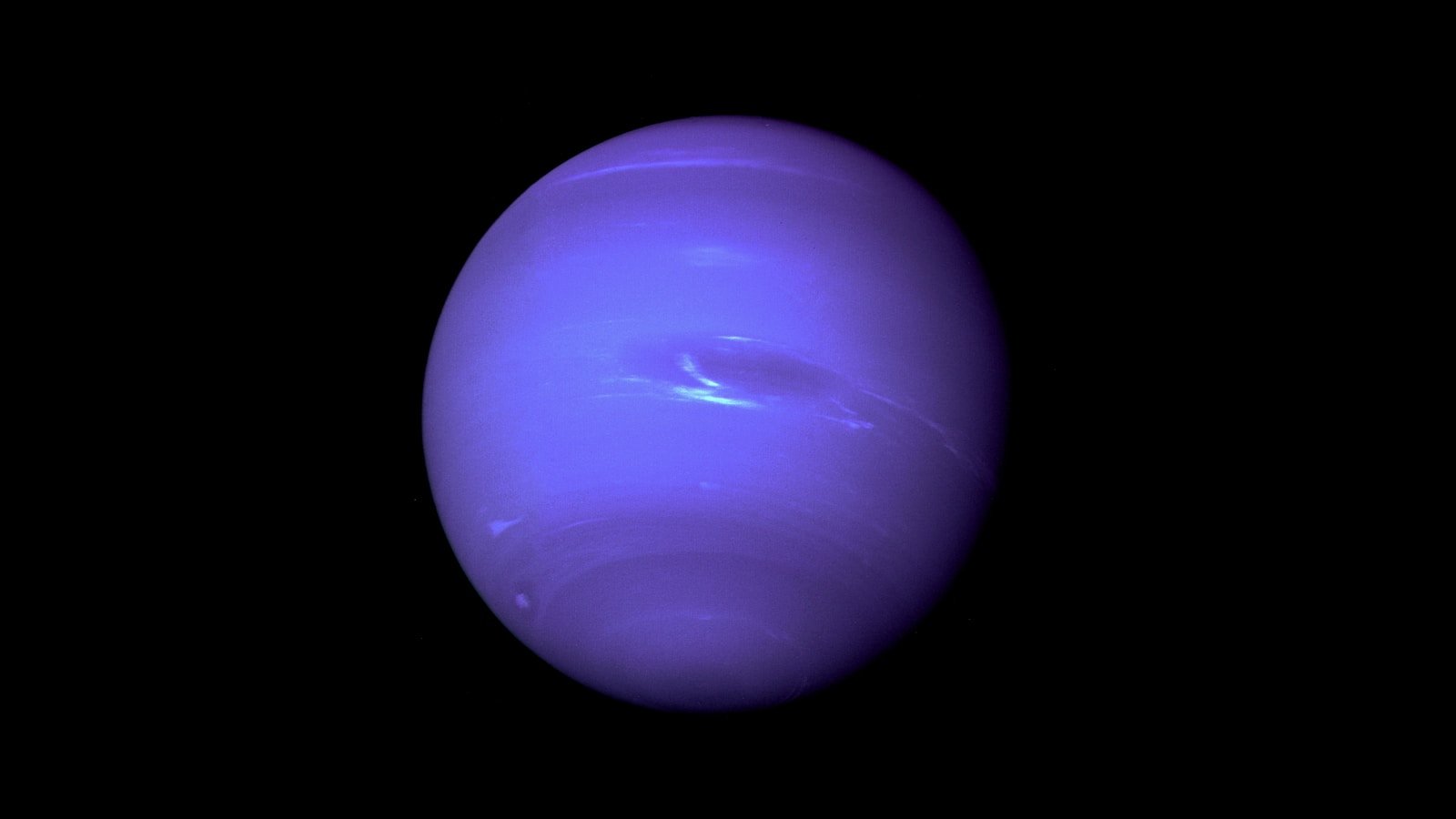
Uranus is one of the most poorly understood planets in the solar system. Voyager 2's brief flyby in 1986 returned a handful of images of what appeared to be a featureless blue-green sphere. Webb is changing that picture entirely.
The 2026 JWST data releases on Uranus include near-infrared and mid-infrared observations that reveal atmospheric banding, ring structure, and — most significantly — evidence of auroral processes in the planet's upper atmosphere and ionosphere.
This guide explains what the new data shows, why Uranus' auroras are so unusual, and what "upper atmosphere mapping" actually means for an ice giant.
Why Uranus is difficult
Uranus presents several challenges that make it harder to study than Jupiter or Saturn:
- Distance: Roughly 19 AU from the Sun. Faint, and small in apparent angular size.
- Axial tilt: 97.8° — it essentially orbits on its side. This produces extreme seasonal variations and a magnetic field axis that is offset ~59° from the rotation axis.
- Atmospheric composition: Hydrogen, helium, and methane dominate. Methane absorbs red light, giving Uranus its blue-green appearance in visible light, but in the infrared the atmosphere shows far more structure.
- No dedicated orbiter: All our detailed knowledge comes from Voyager 2 (1986), Hubble, ground-based telescopes, and now JWST.
What JWST reveals in the infrared
Atmospheric banding
At NIRCam wavelengths (particularly ~1.4 µm, 2.1 µm, and 3.0 µm), Uranus shows distinct latitudinal bands and polar features that are invisible in broadband visible-light images. These bands trace variations in cloud-top altitude and haze opacity.
The polar cap
A bright polar cap appears at the sunlit pole. This seasonal feature reflects the current near-solstice geometry (Uranus reached northern solstice in 2028, so by 2026 the north pole is increasingly tilted toward the Sun and toward Earth's line of sight). The cap is thought to be a region of reduced methane haze, allowing deeper — and brighter — atmospheric layers to be seen.
Ring structure
JWST's sensitivity has resolved the inner and outer rings with clarity previously only possible from close-range spacecraft. The epsilon ring is the brightest, but fainter inner dusty rings are also visible.
Auroras on Uranus — why they are unusual
On Earth, Jupiter, and Saturn, auroral emissions are driven by charged particles spiralling along magnetic field lines and exciting atmospheric gases near the magnetic poles. The magnetic and rotational poles are roughly aligned on those planets, so auroras form near-circular ovals around the geographic poles.
Uranus is different:
- The magnetic dipole axis is tilted ~59° from the rotation axis
- The magnetic field centre is offset from the planet's centre
- The result is a highly asymmetric, time-varying auroral pattern that does not form neat ovals
What JWST detects
JWST's infrared observations can detect H₃⁺ emission — a molecular ion of hydrogen that is produced in the ionosphere when energetic particles interact with the upper atmosphere. H₃⁺ emits in the near-infrared around 3–4 µm, well within NIRCam's range.
The 2026 data suggests:
- H₃⁺ emission is concentrated near (but not centred on) the magnetic poles
- The emission pattern changes as Uranus rotates, consistent with the offset dipole
- The intensity varies with solar wind conditions, though the coupling mechanism is not yet fully understood
What "upper atmosphere mapping" means
When researchers refer to "mapping the upper atmosphere," they mean:
- Measuring the spatial distribution of emissions (such as H₃⁺) across the disc of the planet
- Correlating those maps with rotation phase and magnetic field models
- Inferring temperature, density, and energy-input profiles in the ionosphere
This is distinct from mapping cloud-top features. The ionosphere is much higher — hundreds of kilometres above the visible cloud deck — and is only detectable through specific spectral signatures.
Why this matters
Understanding Uranus' atmosphere and magnetosphere is not just an academic exercise:
- Uranus and Neptune represent the ice giant class of planet, which appears to be the most common type of planet in the galaxy (based on exoplanet surveys)
- The offset magnetic field and extreme axial tilt make Uranus a natural laboratory for testing magnetospheric physics under conditions very different from Earth's
- A future Uranus orbiter mission (recommended by the 2023–2032 Planetary Science Decadal Survey) would benefit enormously from the baseline dataset JWST is building now
Viewing Uranus data
- MAST Portal (STScI) — search for Uranus JWST observations
- NASA Webb Image Gallery
FP Softlab's gallery of solar system images includes reference imagery of the outer planets, and tools like Jupiter3D demonstrate the kind of 3D planetary visualisation that future Uranus-focused tools could build on.