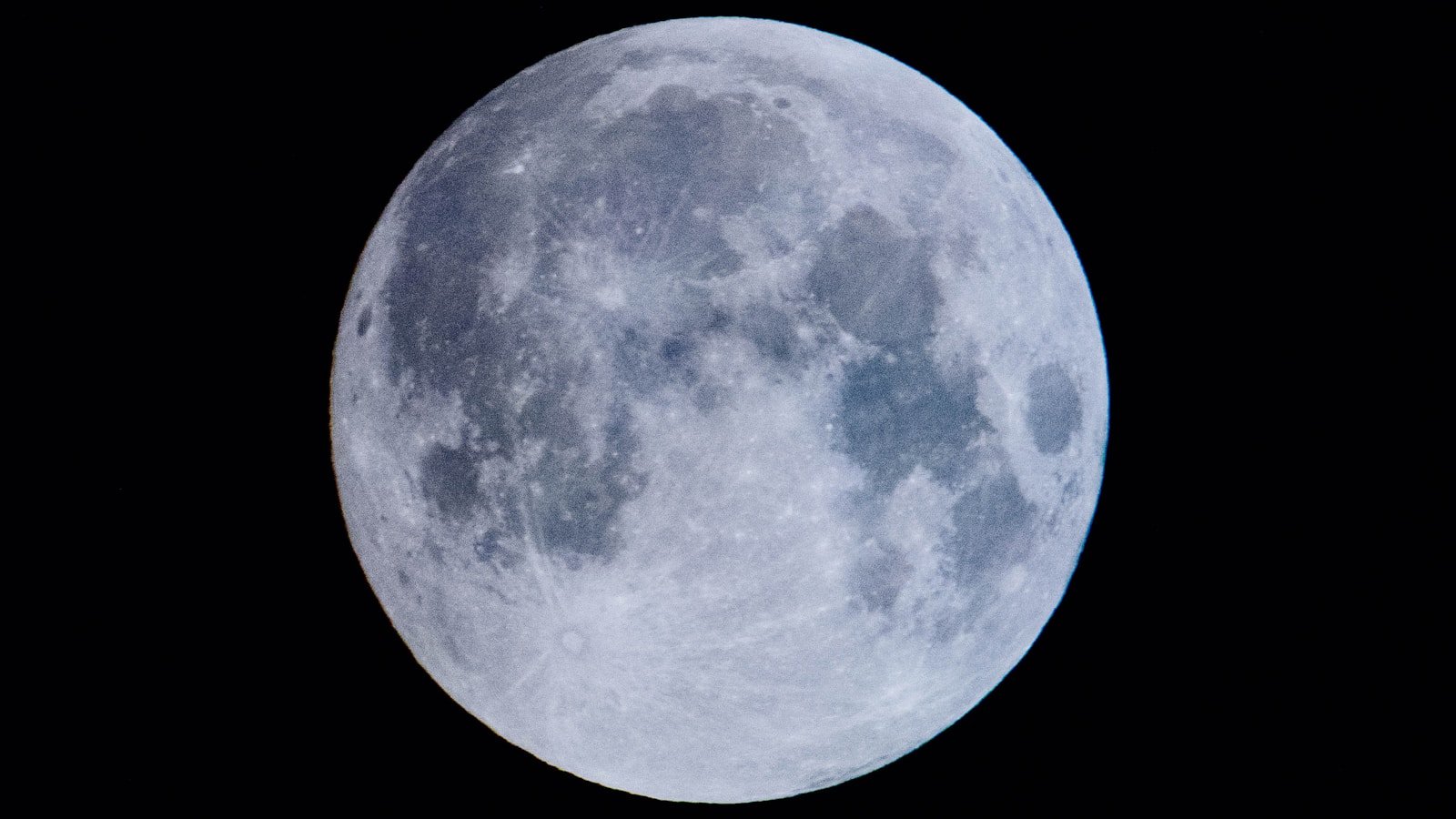
Image: NASA
Two weeks after the total solar eclipse of 12 August 2026, the Moon passes through part of Earth's shadow on the night of 27–28 August 2026, producing a partial lunar eclipse visible across Europe, Africa, and western Asia. From the UK, the entire event is observable from start to finish.
This guide gives you the UK timing, tells you what to expect visually, and walks through practical camera settings for recording the umbral shadow on the lunar surface.
Quick-scan summary
| Detail | Value |
|---|---|
| Date | Night of 27–28 August 2026 |
| Type | Partial lunar eclipse |
| Maximum eclipse | ~03:13 UTC (04:13 BST) |
| Umbral magnitude | ~0.37 (roughly a third of the Moon enters the umbra) |
| Visible from UK? | Yes — entire eclipse above the horizon |
| Equipment needed | Naked eye, binoculars, or any camera with a telephoto lens |
What happens during a partial lunar eclipse?
During a lunar eclipse, the Earth passes between the Sun and the Moon. The Moon enters Earth's shadow, which has two parts:
- Penumbra — the outer, lighter shadow. Difficult to see with the naked eye early on.
- Umbra — the dark inner shadow. This produces the visible darkening on the Moon's surface.
In a partial eclipse, only part of the Moon enters the umbra. You will see a curved dark bite gradually move across the lunar disc.
Unlike a solar eclipse, no special eye protection is needed to watch a lunar eclipse.
UK timing (BST = UTC+1)
| Phase | UTC | BST |
|---|---|---|
| Penumbral eclipse begins | ~00:28 | 01:28 |
| Partial (umbral) eclipse begins | ~01:28 | 02:28 |
| Maximum eclipse | ~03:13 | 04:13 |
| Partial (umbral) eclipse ends | ~04:58 | 05:58 |
| Penumbral eclipse ends | ~05:58 | 06:58 |
The Moon will be in the south-west to west during the deepest phase. From most of England, Scotland, and Wales it will be comfortably above the horizon throughout.
Times are approximate. Check timeanddate.com for precise circumstances at your location.
What will it look like?
At maximum, roughly a third of the Moon's diameter will be inside the umbra. The shadowed portion will appear noticeably darker — often with a warm, coppery or reddish-brown tint caused by sunlight refracted through Earth's atmosphere.
The boundary between the sunlit and shadowed parts is the curved edge of Earth's shadow, which is always circular regardless of viewing angle — one of the earliest observed proofs that the Earth is a sphere.
If you watched the total solar eclipse earlier in August, this lunar eclipse is its companion event in the same eclipse season.
How to photograph the umbra
Equipment
- Any DSLR, mirrorless camera, or bridge camera with manual controls
- A telephoto lens: 200 mm minimum, 400–600 mm ideal
- Sturdy tripod
- Remote shutter release (or use the camera's timer)
Settings for each phase
Before umbral contact (full Moon, very bright)
| Setting | Value |
|---|---|
| ISO | 100–200 |
| Aperture | f/8–f/11 |
| Shutter | 1/250 s – 1/500 s |
During partial umbral phase (shadow visible)
| Setting | Value |
|---|---|
| ISO | 400–800 |
| Aperture | f/5.6–f/8 |
| Shutter | 1/30 s – 1/125 s |
The challenge is that the sunlit portion is much brighter than the shadowed portion. Bracket your exposures: take a set of frames exposed for the bright limb and another set exposed for the shadow detail.
Capturing the umbral colour
To bring out the coppery tint in the umbra:
- Expose for the shadow (let the bright side overexpose)
- ISO 800, f/5.6, 1/15 s – 1/4 s depending on depth
- Shoot in RAW for maximum latitude in post-processing
Focus
Use live-view magnification on a bright crater along the terminator and manually focus until the crater rim is sharp. Lock focus and do not touch the focus ring again.
Observing without a camera
A partial lunar eclipse is one of the easiest astronomical events to enjoy with no equipment at all. Look south-west between 02:30 and 05:30 BST and the shadow will be plainly visible. Binoculars (7×50 or 10×50) will show the colour gradient beautifully.
Related tools
FP Softlab's Moon3D can help you familiarise yourself with the lunar surface features that will be visible along the shadow boundary. The gallery includes reference lunar imagery.