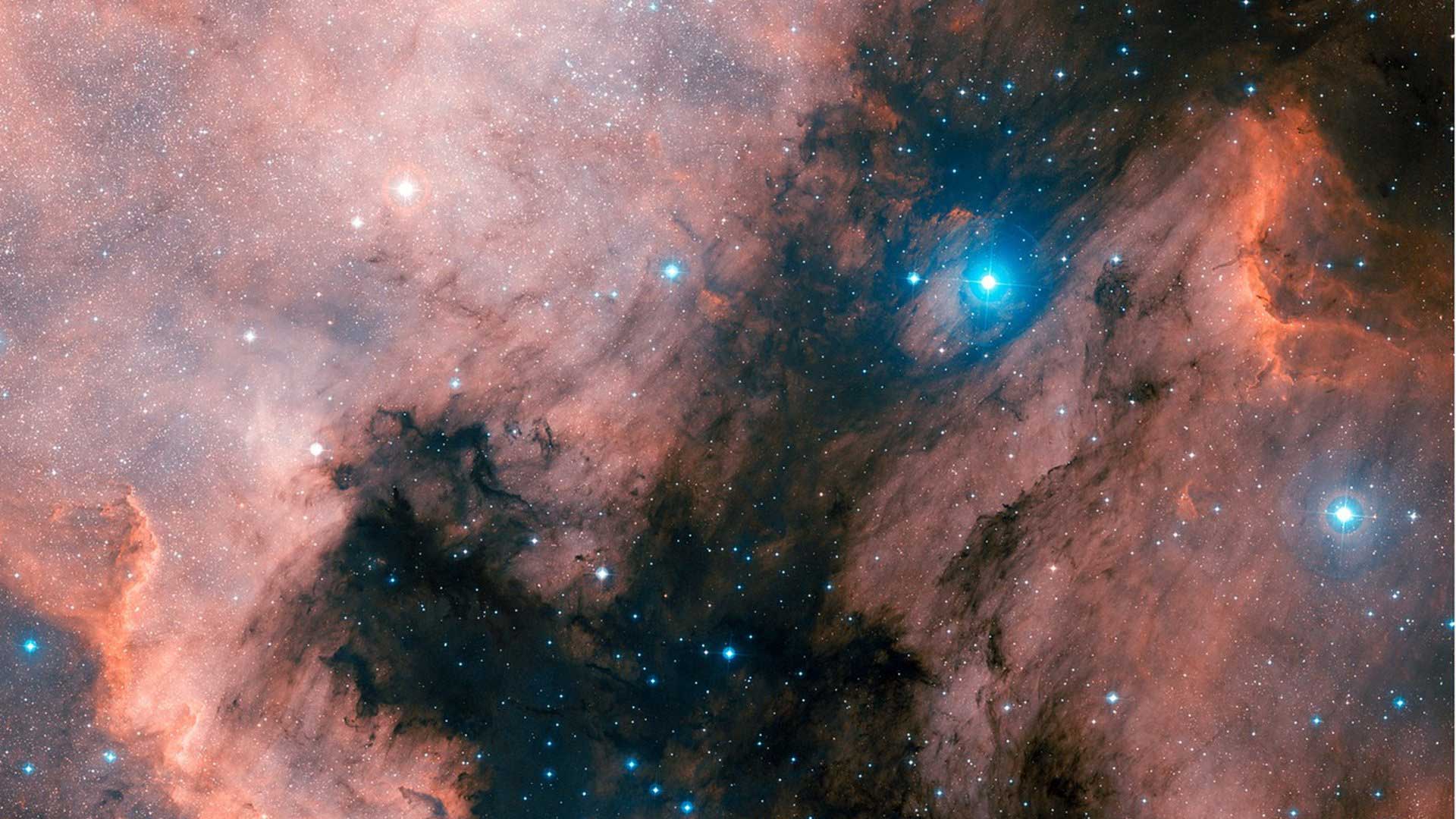
NGC 7000
The North America Nebula in Cygnus
Overview
NGC 7000, the North America Nebula, is one of the most recognizable emission nebulae in the northern sky. Located in the constellation Cygnus near the bright star Deneb, this stellar nursery earned its name from its striking resemblance to the shape of the North American continent when viewed through telescopes or long-exposure photography.
Despite its visual brightness (magnitude ~4), the nebula's large angular size (about 120 by 100 arcminutes—roughly four times the diameter of the full Moon) spreads its light over a wide area, making it challenging to observe visually without dark skies and optical aids. However, this same characteristic makes it an excellent target for wide-field astrophotography.
Quick Facts
Distance
Approximately 1,600 to 2,200 light-years from Earth (estimates vary based on measurement technique)
Physical Size
Spans roughly 50 to 100 light-years across, making it one of the larger nearby emission nebulae
Nebula Type
H II region (emission nebula)—clouds of ionized hydrogen gas excited by hot young stars
Ionizing Source
Multiple hot O and B-type stars embedded within the nebula provide the ultraviolet radiation that causes hydrogen to emit light
Angular Size
~120′ × 100′ (arcminutes), roughly four times the apparent diameter of the Moon
Common Filters
Hydrogen-alpha (656.3 nm), Oxygen-III (501 nm), Sulfur-II (672 nm) for narrowband imaging; RGB for broadband color
The "Cygnus Wall" and Dark Features
The nebula's most prominent feature is the dark "Atlantic Ocean" region—a dense molecular cloud of dust and gas that blocks light from the glowing hydrogen behind it. This obscuring dust lane creates the sharp "eastern coastline" of the continental shape. Within this dark region, ongoing star formation is hidden from visible light but detectable in infrared wavelengths.
The bright "Gulf of Mexico" area in the southern portion shows particularly complex structure, with compression fronts, ionization boundaries, and sculpted pillars where stellar winds from hot young stars interact with surrounding molecular clouds. These regions are stellar nurseries, where gravitational collapse continues to form new stars even as existing stars clear out their surroundings.
Neighboring Objects
NGC 7000 is part of a larger star-forming complex in Cygnus. Immediately adjacent (in the same molecular cloud complex) lies the Pelican Nebula (IC 5070), separated from NGC 7000 by a dark dust lane. Together, they represent different ionization zones within the same massive cloud, illuminated by different clusters of hot stars.
The entire region sits within the Cygnus OB2 association, one of the richest young star clusters in our vicinity, containing hundreds of massive O and B-type stars. This stellar association provides the energetic radiation that ionizes the surrounding gas across dozens of light-years.
How Images Are Captured
Photographing NGC 7000 presents distinct challenges due to its large size and relatively low surface brightness:
Broadband Imaging
Traditional RGB (red-green-blue) filters capture all visible wavelengths within each color band. This approach produces natural-color images showing the nebula's red hydrogen emission and blue oxygen emission together. However, broadband imaging is highly susceptible to light pollution, making it practical only from dark-sky locations. Typical exposures range from 3 to 10 minutes per frame, with total integration times of 2–6 hours across RGB channels.
Narrowband Imaging
Narrowband filters isolate specific emission lines—typically hydrogen-alpha (H-alpha), oxygen-III (OIII), and sulfur-II (SII). Each filter captures only a narrow wavelength range (3–12 nanometers wide), dramatically improving contrast and rejecting light pollution. This technique allows suburban astrophotographers to capture faint emission nebulae despite significant sky glow.
Narrowband data is usually captured in separate sessions per filter, then combined in post-processing. Common mappings include:
- Natural color: H-alpha → red, OIII → green/blue
- Hubble Palette: SII → red, H-alpha → green, OIII → blue
- HOO bicolor: H-alpha → red/green, OIII → blue
Total integration times for narrowband imaging often exceed 10–20 hours to capture faint structural details, with exposure lengths typically 5–15 minutes per frame depending on the camera and light pollution level.
Visual Observation Tips
While wide-field photography reveals NGC 7000's full extent, visual observation requires specific techniques:
- Use binoculars or fast wide-field telescopes: The nebula's large size and low surface brightness favor instruments with fast focal ratios (f/4 or faster) and wide fields of view.
- Dark adaptation is critical: Allow 20–30 minutes for full rod cell sensitivity. The nebula appears as a subtle brightening rather than distinct structure.
- Narrowband filters help: H-alpha or UHC (ultra-high-contrast) filters enhance the nebula's visibility by blocking light pollution and skyglow wavelengths.
- Start with Deneb: The bright star Deneb serves as a reference point—NGC 7000 lies about 3° east (roughly six Moon widths).
- Use averted vision: Looking slightly to the side of the nebula activates more sensitive rod cells in your peripheral vision, revealing fainter structures.