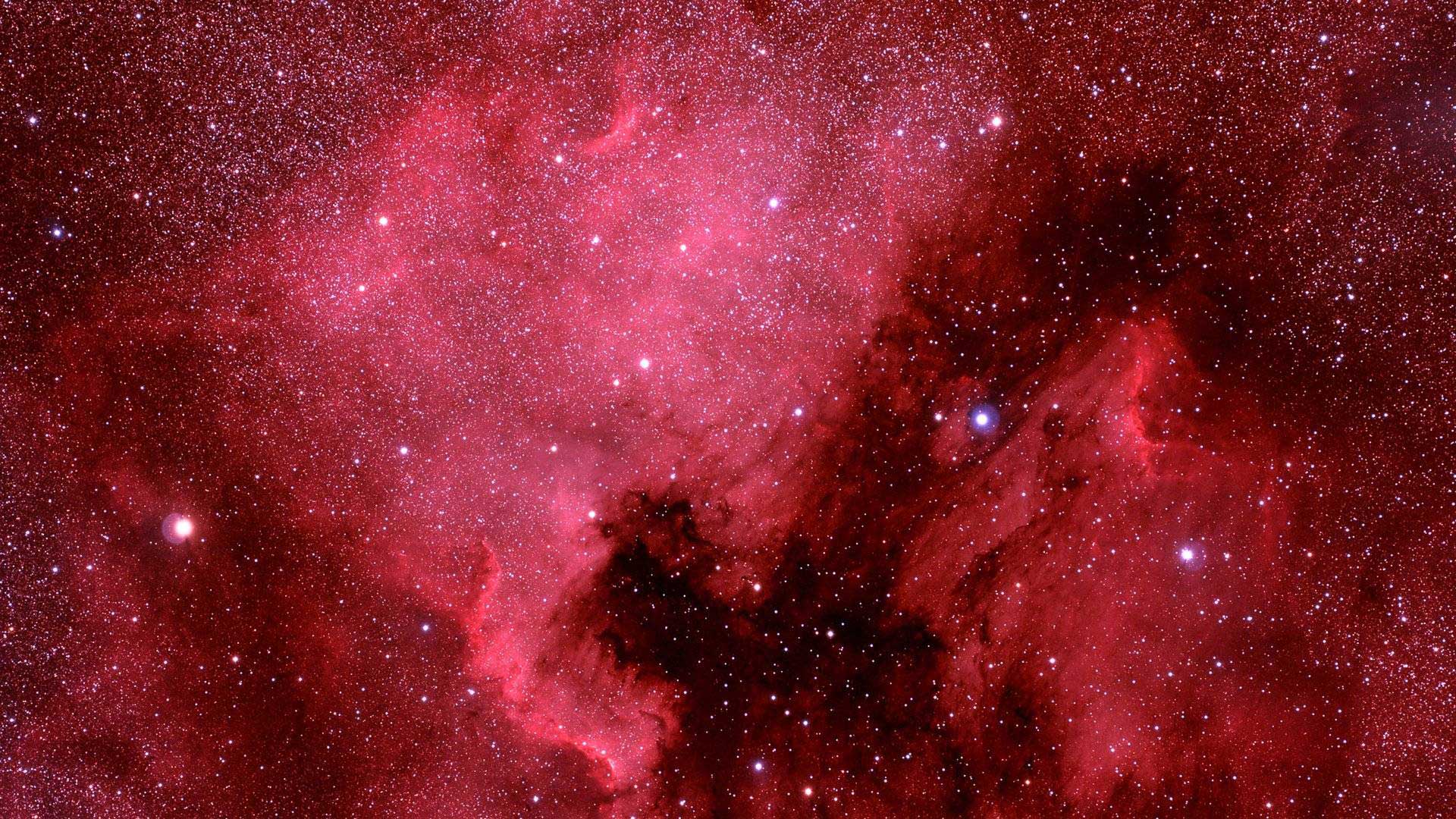
Cygnus / NGC 7000 Mosaic (Hydrogen)
Hydrogen-emission imaging of the North America Nebula
What You're Looking At
NGC 7000, commonly known as the North America Nebula, is a large emission nebula in the constellation Cygnus. Located approximately 1,600 light-years from Earth, this stellar nursery spans roughly 50 light-years across and resembles the shape of the North American continent when viewed through wide-field telescopes.
This hydrogen-alpha (H-alpha) mosaic captures the nebula's structure by isolating light emitted when hydrogen atoms are excited by ultraviolet radiation from hot, young stars. The H-alpha wavelength (656.28 nanometers, deep red) reveals intricate details of the ionized gas where new stars are forming. The darker regions aren't empty—they're dense dust lanes that block background light, creating the distinctive "coastline" that gives the nebula its name.
Understanding the Structure
The North America Nebula's distinctive features become apparent in hydrogen-emission imaging:
- The "Atlantic Ocean" dark region: A dense molecular cloud of dust and gas that obscures background stars and creates the nebula's eastern edge. This dust lane is where some of the most active star formation occurs.
- Bright emission regions: Areas where ultraviolet light from hot O and B-type stars ionizes surrounding hydrogen gas, causing it to emit at the characteristic H-alpha wavelength.
- Structural filaments: Thin strands of ionized gas shaped by stellar winds and radiation pressure from newborn massive stars.
- The "Gulf of Mexico" region: A particularly active star-forming zone with complex structures created by competing forces of stellar winds and gravitational collapse.
Why Hydrogen-Alpha Imaging?
Narrowband imaging using hydrogen-alpha filters offers several advantages for capturing emission nebulae:
Contrast Enhancement
By isolating a single wavelength, H-alpha filters dramatically improve contrast against sky glow and light pollution, revealing faint structures invisible to broadband imaging.
Penetrates Light Pollution
The narrow 3–12 nanometer bandpass rejects artificial light wavelengths, making it possible to capture emission nebulae even from suburban locations.
Reveals Ionized Hydrogen
H-alpha emission directly traces regions of active star formation, as only hot young stars produce enough ultraviolet radiation to ionize surrounding hydrogen clouds.
Long Exposure Capability
The narrow filter bandwidth allows longer individual exposures without saturation, accumulating more signal from faint nebular structures.
Mosaic Imaging Technique
Creating a wide-field mosaic of NGC 7000 requires capturing multiple overlapping frames and stitching them together. This technique combines several imaging challenges:
- Panel overlap: Adjacent frames typically overlap by 20–30% to ensure sufficient matching points for seamless alignment.
- Exposure consistency: All panels require identical exposure times and camera settings to maintain uniform brightness and noise characteristics across the mosaic.
- Flat field correction: Optical vignetting and sensor variations must be calibrated out of each frame before combining, or edges will show brightness gradients.
- Gradient removal: Sky glow and atmospheric extinction often create brightness variations across wide fields that must be normalized during processing.
- Registration precision: Sub-pixel alignment accuracy is critical to avoid seams and maintain sharpness across panel boundaries.
Viewing Notes
While narrowband H-alpha images display in greyscale by default, they're often colorized in post-processing. Common approaches include:
- Mapped to red: The most natural choice since H-alpha light is deep red (656.3 nm), though this often appears too monochromatic for aesthetic preference.
- Hubble Palette (SHO): When combined with sulfur-II and oxygen-III data, H-alpha is typically assigned to green, creating a false-color composite that emphasizes different emission zones.
- HOO combination: Hydrogen-alpha and oxygen-III mapped to red-green-blue channels to create a teal-and-orange aesthetic popular in astrophotography.
In purely hydrogen-emission images like this one, the brightness variations reveal ionization gradients—brighter regions receive more intense ultraviolet radiation, while fainter wisps mark the edges where stellar winds compress gas into thin sheets.
For those experimenting with AI-assisted colorisation or using generative tools to create synthetic nebula palettes, it's worth understanding the capabilities of leading platforms — see this Adobe Firefly vs Midjourney vs Flux vs Dall-e 2026 comparison for a detailed breakdown of how each tool handles complex, detail-rich imagery.